How Does a Blind Child Learn at the Planetarium?
In fifth grade, one of the first field trips students take is to the planetarium. The trip supports their science unit on the moon, sun, and seasons.
But have you ever stopped to think about how a blind child accesses a lesson that is almost entirely visual?
I had a unique perspective on this particular field trip because I’m also a fifth-grade teacher. I got to see some of the planning that went into making sure Titus could participate and learn right alongside his classmates.
And honestly, it was pretty amazing to watch.
Preparing for the Experience
Before the field trip, all the fifth graders participated in science lessons to introduce the concepts and prepare them for what they would learn at the planetarium.
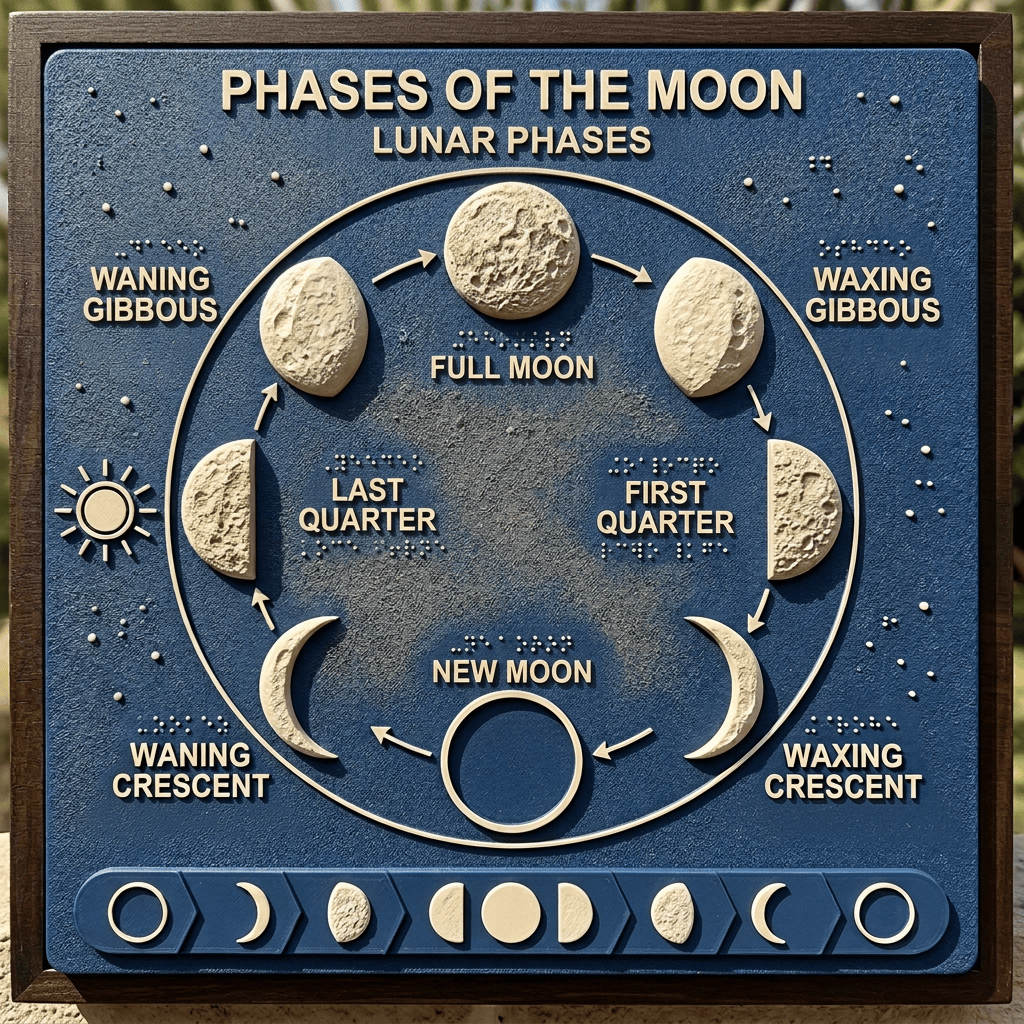
Titus’ teacher of students with visual impairments (TVI) took things a step further by bringing in tactile graphics to help him understand how the moon’s appearance changes throughout the month.
These hands-on materials gave Titus a way to explore the different phases of the moon through touch rather than relying on pictures alone.
The preparation didn’t stop there.
Before the field trip, the planetarium director met with Titus’ TVI and classroom teacher to discuss ideas and suggestions for making the experience meaningful and accessible for him.
I love that they took the time to think through what Titus would need before he even walked through the door.
Learning Alongside His Classmates
When we arrived at the planetarium, a student gave the presentation while Titus sat toward the back of the room. His paraprofessional sat beside him with the tactile materials, and the planetarium director sat on his other side, ready to help as needed.
As the presentation went on, I watched the director use hands-on guidance to help Titus understand the movement of the rising and setting sun. She added descriptions to help explain what was happening rather than relying on the visuals projected on the dome.
I couldn’t hear everything being said because I was busy monitoring my own class, but I could see what was happening.
Titus was included. He was engaged. He was learning alongside his classmates.
And that was exactly what I had hoped to see.
Afterward, Titus said he enjoyed the experience. I was especially amazed that he seemed to understand the concept of shadows. It’s something many of us take for granted because we can see shadows all around us, but Titus has never had that visual experience. Seeing how a concept like this could be explained in a way that made sense to him was pretty incredible.
His paraprofessional even said it was the best field trip he had ever had!
A First for the Planetarium Director
Later, I learned that this was the first time the planetarium director had ever assisted with a descriptive lesson for a blind child.
She had been a little nervous about how it would go.
Would the adaptations work? Would Titus be able to follow along? Would the experience be successful?
In the end, she described it as a highlight of her career.
I love hearing that.
Here was someone willing to step outside what was familiar, collaborate with Titus’ teachers, try something new, and create an experience that made a difference for a student.
And it wasn’t just Titus who benefited. The director gained a new experience, too.
Why We Share Our Story
These are the moments that remind me why we share our family’s story through Amazingly Blind.
We want to challenge the assumption that blindness means someone can’t participate in an activity, learn a subject, or experience something that others might take for granted.
Sometimes there are barriers. Sometimes an experience needs to look a little different. And sometimes it takes extra planning, creative thinking, and a willingness to try something new.
But that doesn’t mean it can’t be done.
What stood out to me most about this field trip wasn’t one particular adaptation. It was the thought and collaboration that went into making sure Titus had the opportunity to learn alongside his classmates.
His teachers and the planetarium director worked together to figure out what he would need. They didn’t expect him to simply sit through a visual presentation and hope he understood. They found ways to help him access the information.
And the benefits go both ways.
Titus had the opportunity to learn about the sun, moon, and seasons in a meaningful way. His classmates got to share the experience with him. And the planetarium director discovered a new way to teach that she may carry with her into future presentations.
Sometimes making something accessible doesn’t just change the experience for one person. It opens up new possibilities for everyone.
That’s what we hope to show through our stories. Blindness may change how Titus experiences the world, but with a little creativity, collaboration, and a willingness to do things differently, there is so much he can learn and experience.
And sometimes, everyone involved walks away having learned something new.